Nerosium Grinder
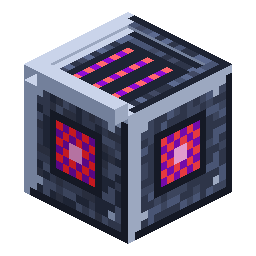
Your first machine — grinds ore into dust to double your metal yield.
Overview
The Nerosium Grinder processes nerosium inputs into Nerosium Dust over time. Since each dust smelts back into a Nerosium Ingot, grinding ore before smelting doubles your ingot output.
Obtaining
Craft (shaped):
I I I
I F I
C C C
I = Nerosium Ingot · F = Furnace · C = Cobblestone
How it works
-
Slots: an input (top/sides) and a four-slot output buffer (extracted from the bottom). The buffer gives pipes room to keep up; if it fills, the grinder pauses rather than overflowing.
-
Grinding recipes:
- Nerosium Ore / Deepslate Nerosium Ore / Raw Nerosium → 2 Nerosium Dust
- Nerosium Ingot → 1 Nerosium Dust
- Nerosteel Ore → 2 Raw Nerosteel
- Cindrite Ore → 2 Cindrite · Glacite Ore → 2 Glacite · Xertz Quartz Ore → 2 Xertz Quartz
The ore-block recipes mean silk-touched ore (hand-mined or from the quarry's Silk Touch Module) is never a dead end — grind it back into its raw material or gem.
-
Power: it has an internal energy buffer (10,000 FE) and currently self-charges
(~15 FE/tick), spending ~30 FE/tick while grinding. A full grind takes ~100 progress ticks.
-
Automation: the inventory is exposed via the item capability — hoppers/pipes can **insert into
the input from the top or sides and extract dust from the bottom**.
-
GUI: shows a power gauge and grind-progress; emits a comparator signal from its energy level.
Grinding meteor rock — random space materials
Feed the grinder a Meteor Rock and it follows a different, random path: instead of a fixed recipe it produces a weighted-random material drawn from Neroland Core's Meteor Material Registry. Every Nero mod registers its grindable materials into Core once, so the pool grows automatically with whatever mods are installed — the grinder never needs to know about them.
- What you get: one primary material per rock, plus — occasionally — a bonus exotic item. Nerospace contributes its raw materials and signature planet ores to the pool.
- Planet-locked signature ores: each planet's signature ore only enters the pool when you grind on that planet — and is heavily weighted there (the planet-bias multiplier). Grind on Greenxertz for Xertz Quartz and Raw Nerosteel, on Cindara for Cindrite, on Glacira for Glacite. Off a planet (e.g. on Earth) those materials drop out entirely. Being on the planet is the gate — there's no separate progression lock, so you can never be stranded on a world unable to grind its own ore.
- Progression-gated alien tech: the alien materials aren't tied to a planet, so they can roll on any world — and are instead paced by Core gates. Alien Fragments unlock at Reached Orbit; Alien Tech Scrap and the exotic Alien Core at First Colony. This keeps the rare end-game drops out of early overworld meteor grinds.
- Operator context: the gate/planet check uses the operator — the last player to open the grinder, or the owner of the station it sits in. With no operator online (and no eligible material) the grind simply waits, so an unattended grinder never wastes a rock. If the output buffer is full, the grinder pauses with the result held and the meteor rock kept — it never drops items into the world; grinding resumes the moment a slot frees up.
- Recipe book: the random pool is browsable in JEI or EMI — look up the grinder and the meteor entry shows
the whole
neroland:meteor/grindablematerial set.
Privacy: the registry stores no player data — only item metadata. The operator is held by UUID for gate context only, never logged (POPIA/GDPR).
Tips
Feed it raw nerosium or ore, pipe the dust into a furnace array, and you get 2 ingots per ore instead of 1. Save your Meteor Rocks for the random-material grind — and grind them on the matching planet to bias the roll toward that planet's signature ore.
Details
- ID:
nerospace:nerosium_grinder· Tool: pickaxe, iron tier · Drops: itself